Buyer Guide · August 24, 2026
Winter EV Charging at Home: What Actually Changes When It's Cold
Cold weather does slow EV charging and cut range — that part is real. What's less understood is how much of that penalty a good home Level 2 charger avoids, simply by doing most of its work overnight, at a steady rate, in a garage or driveway rather than at a public fast charger. Here's what changes for Canadian EV owners once temperatures drop, and how to charge smarter through it.
Why cold slows charging in the first place
Lithium-ion batteries rely on chemical reactions that simply run slower when cold. Natural Resources Canada notes that EVs work best in moderate temperatures — roughly 10°C to 40°C — and that charging or discharging a battery below about 10°C can reduce capacity and, over time, shorten its lifespan if the vehicle doesn't manage it properly. NRCan also points to a real-world efficiency hit: EVs consume roughly 16% more energy at 0°C than at 8°C, mostly from cabin heating and the battery's own thermal management drawing power. None of this is unique to any charger brand — it's basic battery physics, and every EV on the road deals with it.
Level 2 home charging has a built-in advantage
The most noticeable cold-weather charging problems — dramatically slower fill rates, charging curves that taper hard — show up mainly at DC fast chargers, where the battery is asked to accept a lot of power very quickly while cold. A 240V Level 2 charger delivers power at a much lower, steadier rate over several hours, which is far less sensitive to cold-battery restrictions. The U.S. Department of Energy and multiple charging networks make the same point: overnight Level 2 charging at home lets the vehicle's battery management system keep the pack at a workable temperature throughout the charge, instead of forcing a cold start the way a quick public top-up does. In practice, that means most home charging routines don't change much in winter — you just may notice slightly longer full-charge times and should plan for reduced range on cold-weather trips.
Preconditioning: the one habit worth adding
If there's a single winter habit that makes a real difference, it's preconditioning — warming the battery and cabin while the car is still plugged in, using grid power instead of battery power. Most EVs let you schedule this from the app for a set departure time. Because a home charger is already connected, preconditioning costs you nothing in range: the energy comes from the wall, not the pack. Skipping it and warming up on battery power instead is one of the most common ways drivers lose range unnecessarily in winter.
Protecting the charger and connector outdoors
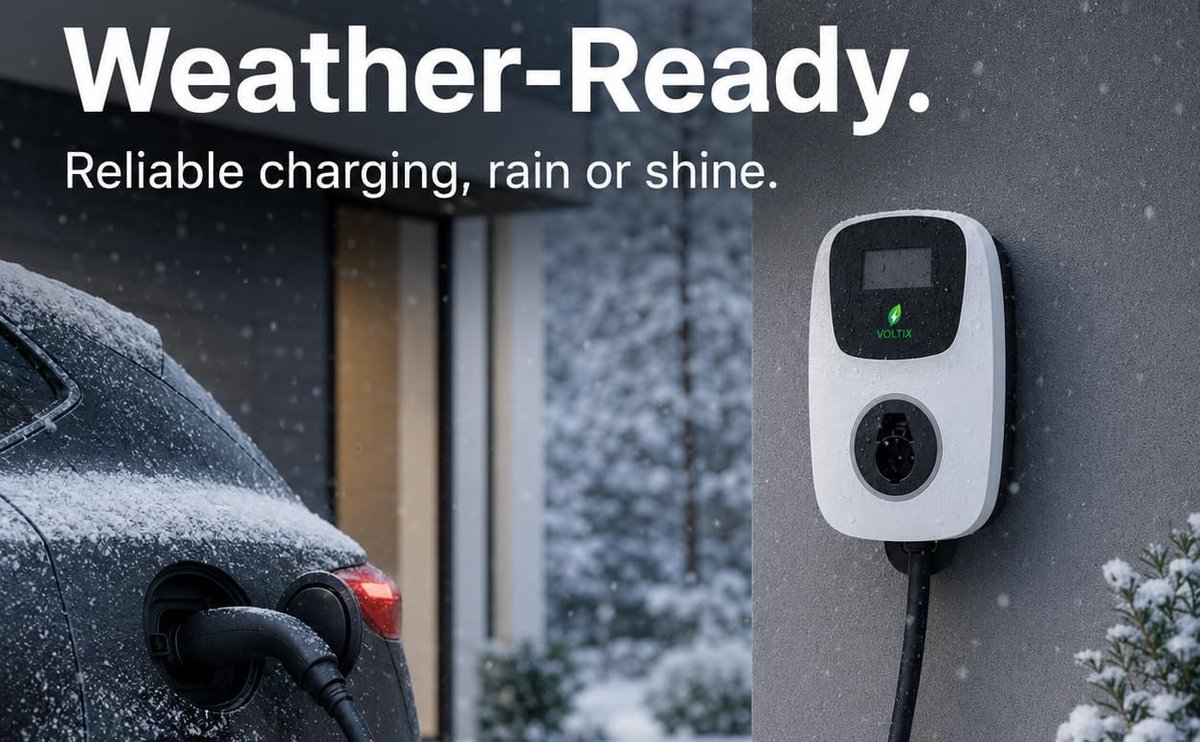
If your charger is mounted outside — a garage exterior wall or a driveway post — winter also means dealing with snow, ice, and road salt around the unit itself. This is where the charger's own weather rating matters, separate from anything happening inside the vehicle. Voltix's enclosure is Type 3R rated for indoor and outdoor installation, including rain, snow, and sleet exposure — built to handle Canadian winters at the charger housing. It's still good practice to keep the connector face down or covered when not in use, and to gently clear built-up ice from the plug before connecting rather than forcing it.
A simple winter checklist
Charge overnight at home rather than relying on public fast charging in cold snaps — it's gentler on the battery and typically cheaper on off-peak rates. Precondition from the app before unplugging, especially on the coldest mornings. Avoid letting the state of charge run low in winter; many battery management systems reserve extra capacity to keep the pack warm when it's cold, so charging exists near-empty can feel worse than usual. And if your charger lives outdoors, a quick visual check for ice buildup before you plug in takes a few seconds and avoids a frustrating start to the morning.
The bottom line
Winter charging isn't something to dread — it's mostly a matter of shifting a few habits toward what a home Level 2 charger already does well: slow, steady, overnight charging with preconditioning built into the routine. The connector and enclosure need to handle the weather; the charging pattern itself barely needs to change. For buyers still comparing chargers ahead of winter, our guide to the best Level 2 charger for Canadian homes covers certification and weather rating in more detail, and the 48A vs 40A comparison is worth a look if you want faster overnight recovery on shorter winter days.
Built for Canadian weather
Voltix is a 48A hardwired Level 2 charger, Type 3R rated for outdoor installation and ETL Listed for safety.
Rebate deadlines & new guides, by email
Charger rebate rules and approved-model lists change. Get a short note when programs change or we publish a new guide. No spam.