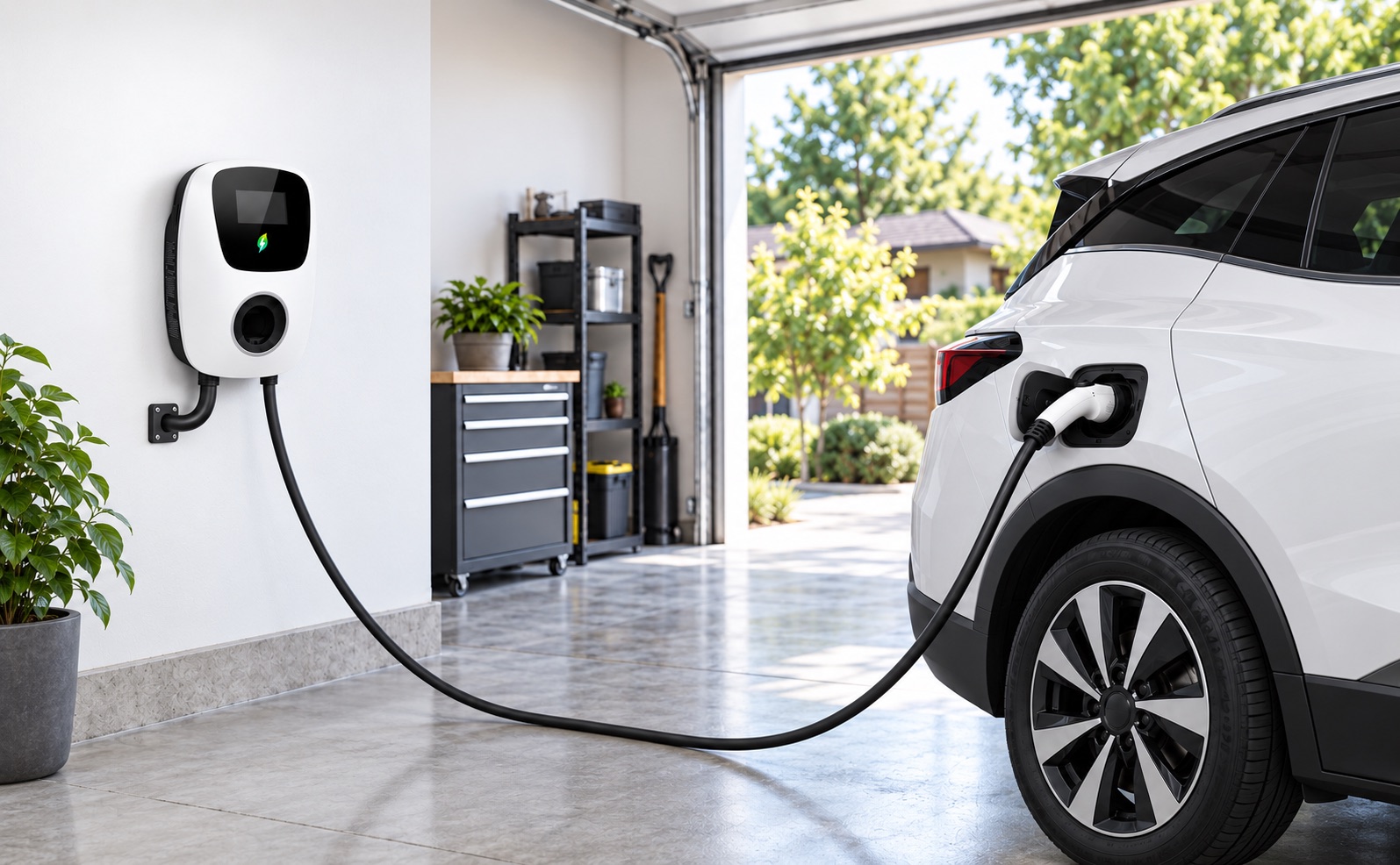
Voltix Level 2 EV Charger installed at home

Level 2 Home EV Charger

Wake Up to a Full Charge. Every Single Day.

11.5 kW · 48A · 25 ft Cable · WiFi Smart App · ETL Listed

11.5 kW
Max Output
Faster than L1
25 ft
Heavy-Duty Cable
★ 5.0
ETL Listed

Why Voltix

Built Different.

What sets the Voltix apart — faster charging, certified safety, and all-weather reliability.
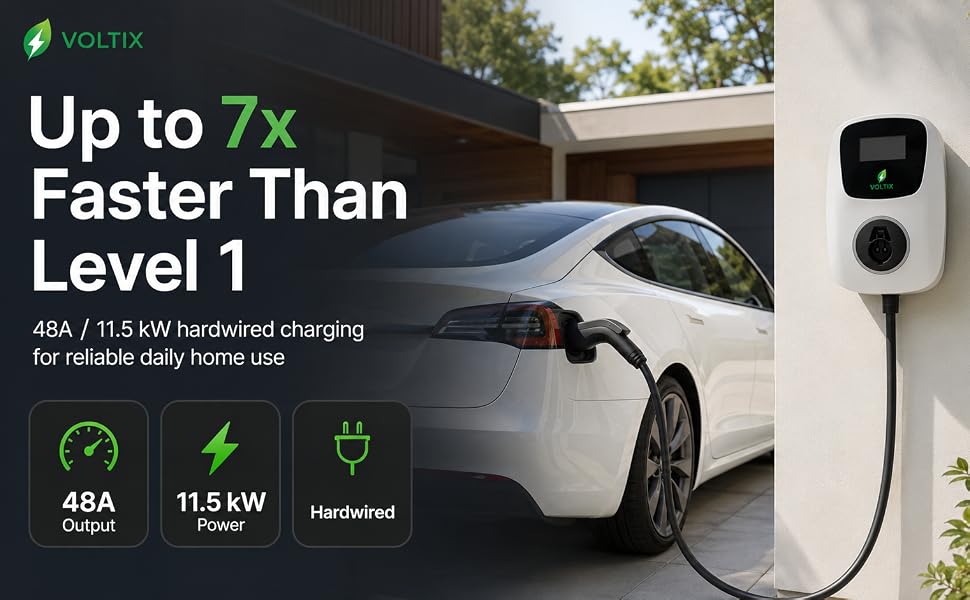
7x Faster Home Charging

48A Maximum Charging Speed

Delivers a full 11.5 kW — adding roughly 60–70 km of range per hour. Roughly 7× faster than a standard Level 1 wall outlet, so your car is ready when you are.
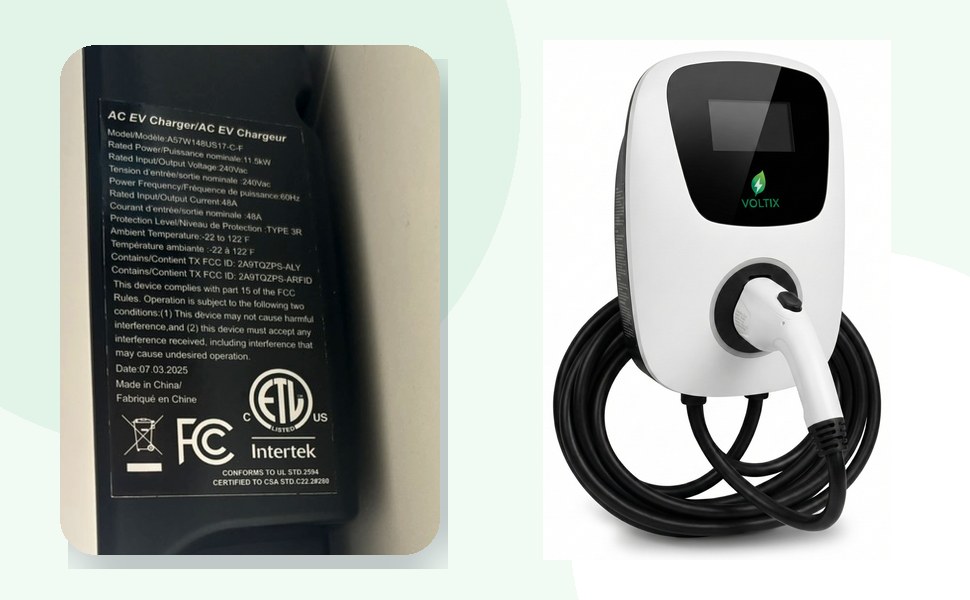
ETL Listed & UL 2594 certified Voltix charger

ETL Certified Safety

ETL Listed (Intertek) to UL 2594 and CAN/CSA-C22.2 No. 280. Built-in CCID20 leakage protection, over-voltage and surge safeguards, and automatic thermal shutoff at 95°C.
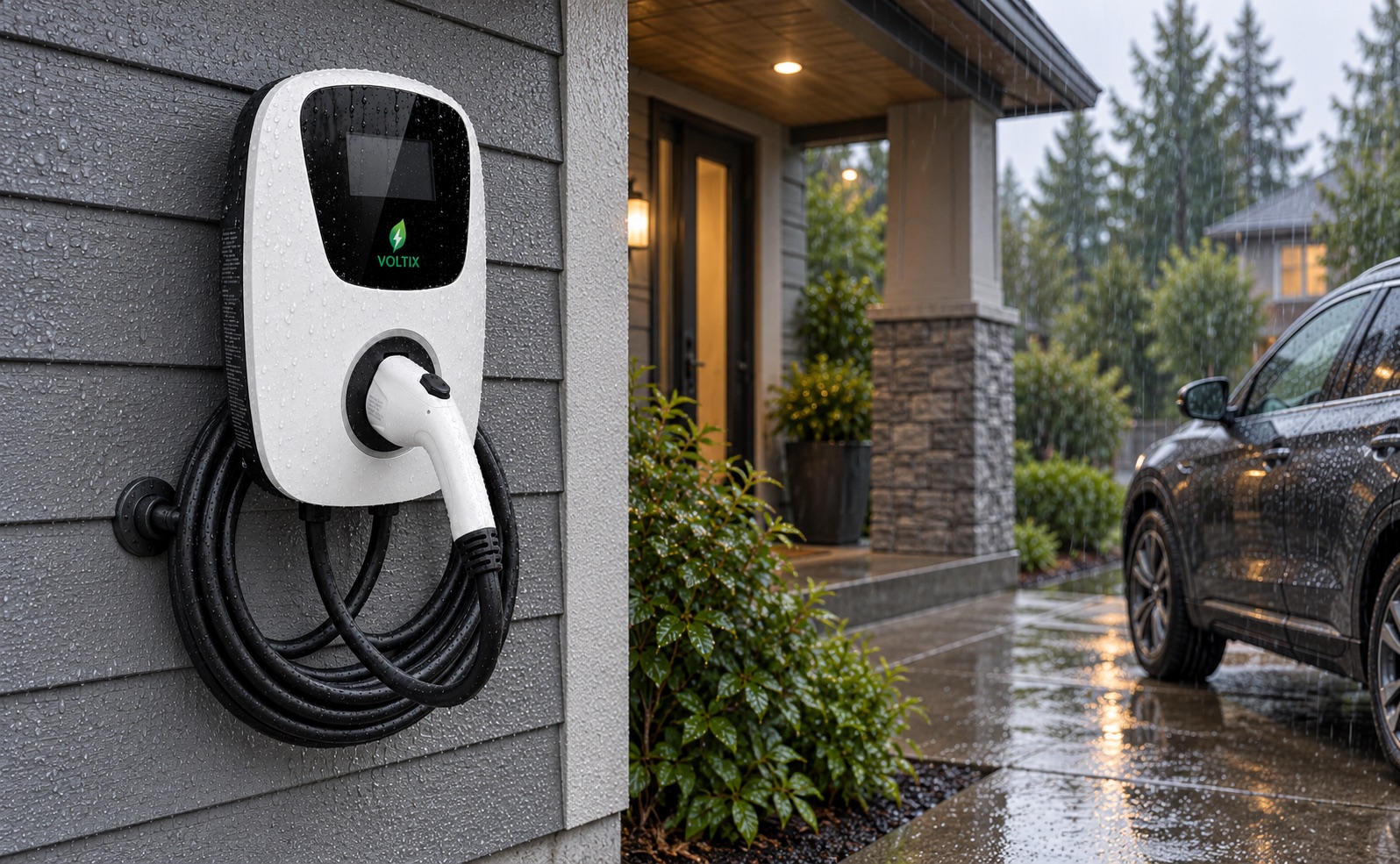
Voltix installed outdoors in winter snow

Type 3R Weatherproof

Rated Type 3R for superior water and dust resistance — safe for indoor garages and outdoor driveways alike. Built to handle Canadian winters and summer heat without missing a charge.

Smart Control

Your Charger.
In Your Pocket.

The free Smart Life App (iOS & Android) pairs with Voltix via WiFi and Bluetooth, putting complete control in your hands — from anywhere.

  • Schedule off-peak charging

    Automatically start charging when electricity rates are lowest to cut costs.

  • Adjust amperage remotely

    Set output anywhere from 16A to 48A to match your home's load.

  • Track energy consumption history

    Monitor total kWh usage, session history, and live voltage and current data.

  • 4.3" on-unit LCD display

    Real-time current, voltage, temperature, and session duration on the charger itself.
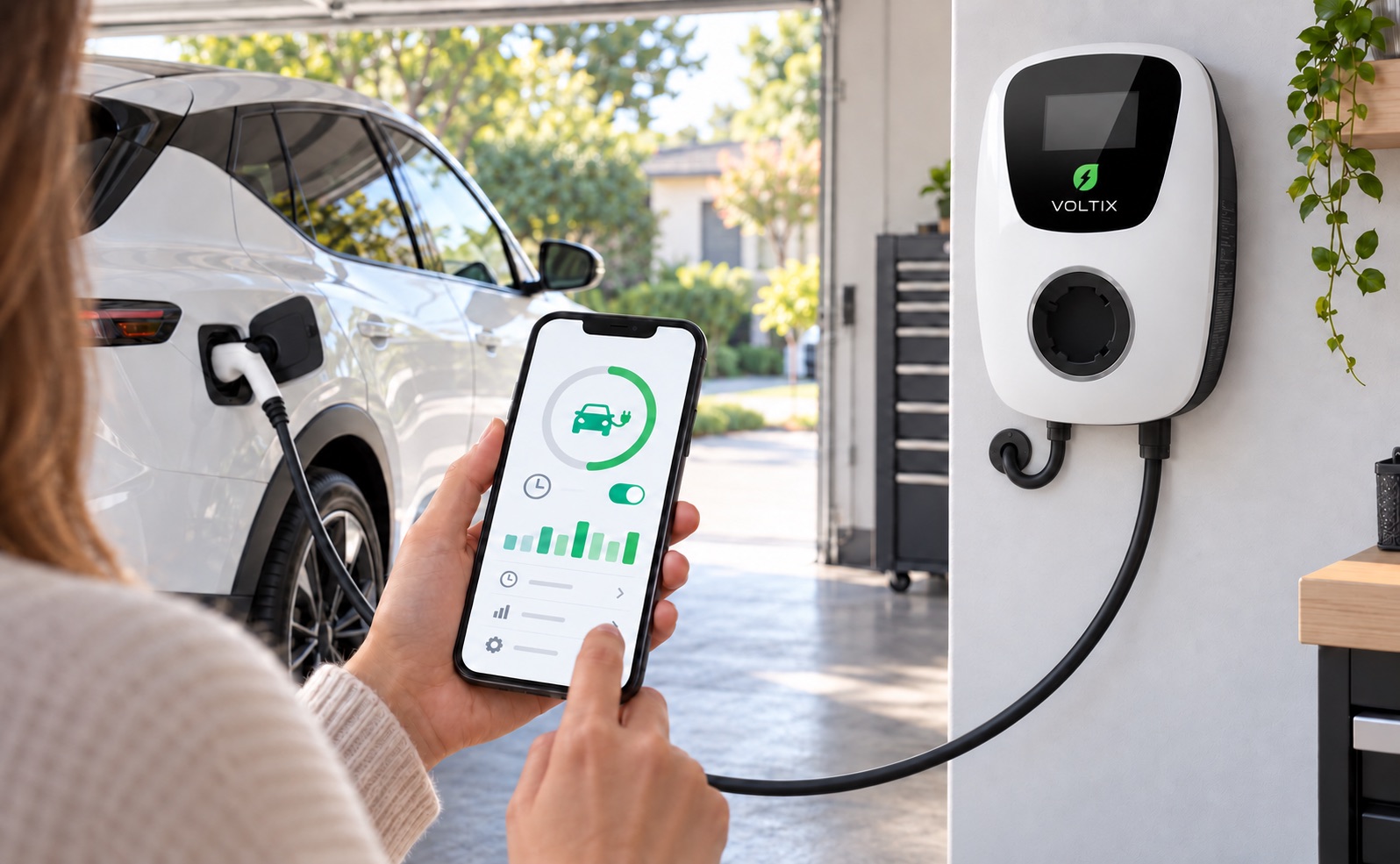
Smart Life App controlling Voltix charger

Everything on paper

Full Specifications

Every detail, laid out clearly.

Power & Performance

Max Power Output11.5 kW
Amperage48A (adjustable 16A–48A)
Voltage240V AC
Charging SpeedUp to 60–70 km of range per hour
vs Level 17× faster than standard wall outlet

Hardware

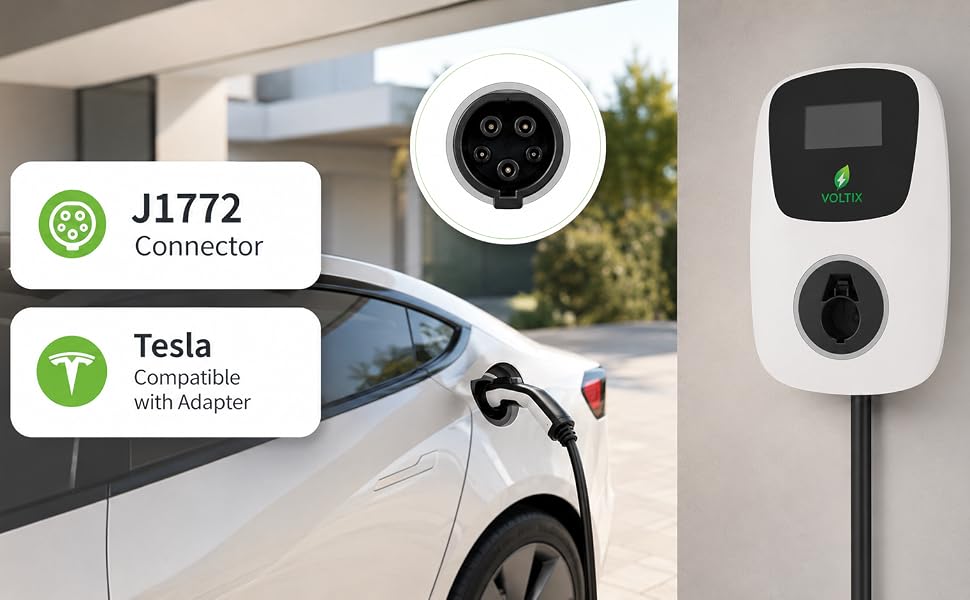
ConnectorSAE J1772 (5-pin)
Cable Length24.6 ft / 7.5 m heavy-duty
Display4.3-inch LCD
InstallationHardwired (requires 60A breaker)
Dimensions13D × 25.7W × 36.8H cm
Weight8.6 kg

Smart Features

ConnectivityWiFi + Bluetooth
AppSmart Life (iOS & Android, free)
App FeaturesSchedule charging, monitor kWh, adjust amperage

Safety & Certifications

ETL CertificationUL 2594 & CAN/CSA-C22.2 No. 280
ProtectionCCID20 leakage, over-voltage, surge
Thermal ShutoffAuto cutoff at 95°C
Enclosure RatingType 3R (weatherproof)
OtherEnergy Star Rated

Purchase & Warranty

AvailabilityAvailable on Amazon
FinancingFrom $45.22/mo (18-month plan)
Warranty2-year limited warranty
ModelA57W132US17

SAE J1772 Standard

Works with Your EV

Compatible with virtually every electric vehicle sold in Canada and the US.

Brand & Models Compatibility Connection
Tesla
Model 3, Y, S, X
Adapter
Use J1772→Tesla adapter (usually included with car)
Hyundai / Kia
Ioniq 5, EV6, Kona
Native
Plugs directly into car's charging port
Ford
Mach-E, F-150 Lightning
Native
Plugs directly into car's charging port
Chevrolet
Bolt EV/EUV, Silverado EV
Native
Plugs directly into car's charging port
Volkswagen
ID.4, ID. Buzz
Native
Plugs directly into car's charging port
Rivian
R1T, R1S
Native
Plugs directly into car's charging port
BMW, Audi, Mercedes
All North American EVs & PHEVs
Native
All use the J1772 standard plug
* For general North American AC charging using the SAE J1772 standard connector.

Installation

Simple Installation.

Three steps and you're charging.

1

Mount & Wire

Have a licensed electrician mount the station and hardwire it to your 60A dedicated 240V circuit.

2

Connect to App

Download the free Smart Life App and pair over WiFi or Bluetooth to set your schedule and amperage.

3

Plug In & Charge

Plug in and charge at up to 11.5 kW — wake up every morning to a car ready to go.

Certified & Verified

ETL Listed
Intertek
UL 2594
Safety Standard
CSA
CAN/CSA C22.2 No.280
Type 3R
Weatherproof
Energy Star
Rated
2-Year
Warranty

Got Questions?

Common Questions

Everything you need to know — from buying to installation to daily use.

What is the difference between Level 1, Level 2, and DC Fast Charging?
Level 1 (120V, ~1.4 kW) uses a standard wall outlet and adds about 8 km of range per hour — adequate for PHEVs, impractically slow for most full EVs. Level 2 (240V, up to 19.2 kW) is the home and workplace standard — the Voltix adds ~70 km per hour at 11.5 kW, giving most EV owners a full overnight charge. DC Fast Charging (50–350 kW) charges to 80% in 20–45 minutes at public stations, but frequent use can accelerate battery degradation and should be reserved for road trips.
Is a NEMA 14-50 outlet enough for a Tesla, or do I need a hardwired charger?
A NEMA 14-50 outlet (50A, 240V) is limited to 32A of continuous charging — about 7.7 kW — because NEC/CEC electrical code requires outlets to be derated to 80% of their rated amperage. That gives a Tesla Model Y roughly 9–10 hours for a 20–80% charge. The Voltix hardwired charger runs at a true 48A (11.5 kW), cutting that to ~6.8 hours. Hardwired is also the preferred safety choice — it eliminates the plug-and-socket wear that occurs thousands of times over the charger's lifetime.
What is the difference between a 32A, 40A, and 48A Level 2 charger?
Amperage determines how fast your EV charges — but only up to your car's onboard AC charger limit. A 32A charger delivers ~7.7 kW, 40A gives ~9.6 kW, and 48A like the Voltix delivers ~11.5 kW. Most modern EVs (Ioniq 5, EV6, Model Y Long Range, F-150 Lightning) accept the full 11.5 kW on AC, so you'll use every amp. Older EVs like the Nissan Leaf (6.6 kW onboard charger) will charge at their own limit regardless. The Voltix also lets you dial output between 16A and 48A via the Smart App, so you can throttle down during peak home usage.
Do I need a 200-amp panel, and does installation require an electrician?
Yes, a licensed electrician is required — the Voltix is hardwired to a dedicated 240V circuit, a one-time job that typically takes 1–3 hours. As for panel size: a 48A charger needs a dedicated 60A double-pole breaker. Most Canadian and US homes built after 1990 have 200A service and can handle this without an upgrade. Homes with 100A service may need a panel upgrade ($2,000–$5,000 CAD) or a smart load management device that throttles charging to stay within panel capacity.
Which EVs is the Voltix compatible with?
Voltix uses the SAE J1772 connector — the universal standard for all North American EVs and PHEVs. This includes Tesla (Model 3, Y, S, X — using the J1772 adapter included with every Tesla), Hyundai Ioniq 5/6/Kona, Kia EV6/EV9, Ford F-150 Lightning/Mach-E, Chevrolet Equinox/Silverado/Blazer EV, Rivian R1S/R1T, Nissan Leaf, Volvo EX30/XC40, and Porsche Taycan. If your EV was sold in North America, it works with Voltix.
What is the best home EV charger for a Hyundai Ioniq 5, Kia EV6, or Ford F-150 Lightning?
All three have large batteries and onboard AC chargers that can accept close to 11.5 kW, making a 48A Level 2 charger the clear choice. The Ioniq 5 and EV6 charge from 20–80% in ~6.5 hours on Voltix vs. ~35 hours on a wall outlet. The F-150 Lightning drops from ~72 hours to ~13.5 hours. A lower-amperage 32A or 40A charger would leave significant speed on the table for these vehicles. The Voltix's 25ft cable also accommodates trucks, which position charge ports farther from the wall.
Is it safe to charge my EV in the rain or snow?
Yes, completely safe. The Voltix has a Type 3R weatherproof enclosure rated for outdoor installation in rain, snow, and humidity — built for Canadian winters. All EV charge ports meet the SAE J1772 weather sealing standard, and the connector's proximity-pilot signal means the car will not energize the circuit until the connector is fully latched, so live contacts are never exposed.
Can I save money by charging my EV at night?
Yes — significantly. Most Canadian utilities (BC Hydro, Hydro-Québec, Toronto Hydro, Epcor) offer Time-of-Use (TOU) rates where off-peak electricity (typically 11pm–7am) is 30–50% cheaper than peak rates. Charging a 75 kWh battery from 20–80% at off-peak rates can save $3–$6 per session — up to $1,000–$2,000 CAD per year. The Voltix Smart App lets you schedule charging to start automatically at off-peak hours.
Does charging to 100% every night damage my EV battery?
Most EV manufacturers recommend keeping your daily charge limit at 80% for long-term battery health. Lithium-ion cells degrade slightly faster when held at 100% state of charge for extended periods. Reserve full charges for road trips. The Voltix Smart App lets you set an automatic charge limit so your car stops at 80% every night — a small habit that can extend your battery's useful life by years.
Is the Voltix charger eligible for Canadian government rebates?
Yes. The Voltix is Energy Star certified, which is required to qualify for most Canadian utility and provincial rebate programs. Incentives vary by province — BC Hydro offers up to $350, Hydro-Québec has provided up to $600, and Ontario's programs have offered up to $500. Many municipal utilities offer additional rebates on top. Use the Voltix Incentive Finder to check what's available at your specific address.
Can I charge two EVs with one charger?
A single Level 2 EVSE charges one vehicle at a time. For two EVs, the simplest approach is installing two Voltix chargers on two separate 60A circuits — each car gets a full overnight charge at maximum speed. Alternatively, a dual-port load-sharing EVSE splits one circuit's power between two cars, but each gets roughly half the charging speed.

Ready to Charge Smarter?

Join EV owners who start every day with a full battery. Free shipping · 2-year warranty.

Get in touch

Contact Us

Have a question? We'd love to hear from you.

Voltix AI Assistant
Hi! Ask me anything about installing or using your Voltix charger. I answer only from the manual.