Buyer Guide · September 7, 2026
Home vs Public EV Charging: What You Actually Save in Canada
Roughly 80% of EV charging in Canada happens at home, and the reason is simple arithmetic: home Level 2 charging costs a fraction of what public DC fast charging costs per kilowatt-hour. Here's what the gap actually looks like in dollars, and when paying more at a public charger still makes sense.
The per-kWh gap
Residential electricity in Canada runs, broadly, from about 4¢/kWh (Ontario's Ultra-Low Overnight rate, overnight only) to about 18¢/kWh, depending on your province, utility, and rate plan — Quebec and Manitoba sit near the bottom, Alberta and PEI nearer the top. Public DC fast charging is a different pricing world entirely: major Canadian networks generally charge somewhere between 30¢ and 67¢/kWh, with per-minute or tiered pricing common on top of that. The Globe and Mail's review of fast-charging pricing found exactly this — a wide spread between networks, but consistently several times the cost of home power. For context on where your province's residential rate actually falls, the Canada Energy Regulator's provincial electricity price snapshot is a good primary source.
What that means for a single charge
Take a 60 kWh top-up — a reasonable stand-in for restoring roughly 300 km of range in a mid-size EV. At home on an off-peak or overnight rate, that charge runs somewhere in the $2.50–$8.00 range depending on your province and plan. The same 60 kWh from a public DC fast charger typically runs $20–$40. It's not a marginal difference; it's a multiple.
Why the price gap exists
It isn't arbitrary. Public fast-charging stations carry real costs a home outlet doesn't: high-power hardware, real estate or lease payments, demand charges from the utility for drawing large amounts of power in short bursts, network maintenance, and a profit margin for the operator. Home charging draws from the same flat residential rate that runs your fridge and furnace, spread over hours instead of minutes, which is inherently cheaper to deliver. That's a structural difference, not a temporary promotion — don't expect the gap to close.
What it adds up to over a year
A driver covering about 15,000–20,000 km a year in a typical EV uses roughly 2,500–3,500 kWh annually. Charged almost entirely at home on an off-peak plan, that's roughly $250–$450 a year in electricity. Relying mainly on public fast charging for the same driving, at 30–50¢/kWh, would run closer to $900–$1,700 a year. The gap compounds every year you own the car — which is the real financial case for a dependable home charger, separate from any one-time rebate or promotion.
When public charging still makes sense
None of this makes public fast charging a bad option — it's simply a different tool. It's the right call on road trips, when you don't have a home charger yet, if you live in an apartment or condo without dedicated parking access, or when you need a fast top-up mid-day in an emergency. The goal isn't to avoid public charging entirely; it's to make sure your everyday charging — the 80% that happens at home — is actually landing on the cheap side of the ledger instead of drifting toward public-charger prices by default.
Making home charging actually count
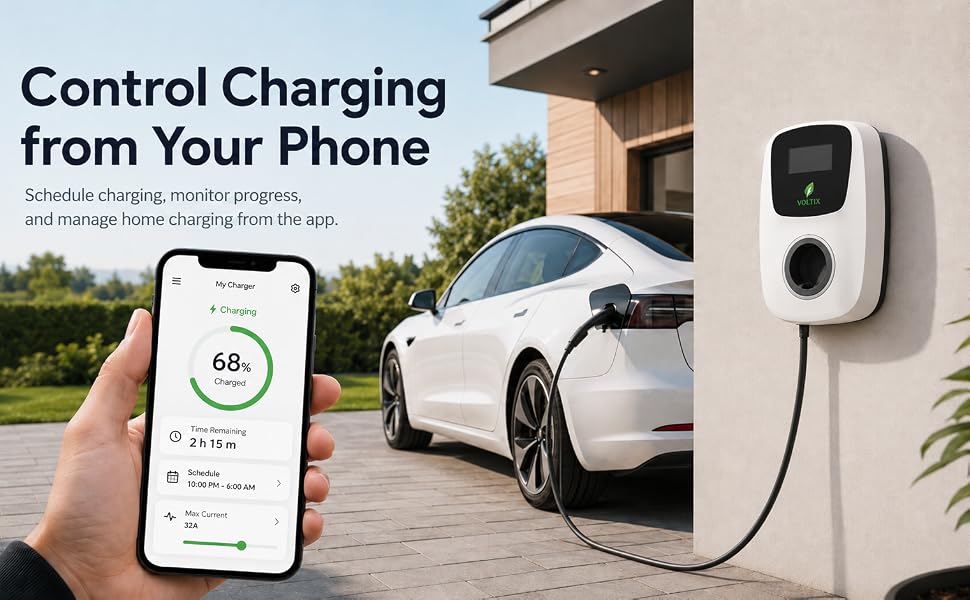
The savings above assume you're charging at an off-peak or overnight rate, which only happens if your charger is actually scheduled for it. A 48A hardwired charger like Voltix delivers up to 11.5 kW and schedules sessions from its app, so charging starts in the cheap overnight window automatically rather than the moment you plug in after work. See our off-peak charging breakdown for how Ontario's specific rate plans compare, and our charging time guide for how long a full charge actually takes at 48A. If a provincial charger rebate is still available where you live, our Incentive Finder checks that in under a minute.
Make every charge a cheap one
Voltix is a 48A hardwired Level 2 charger with app-based scheduling, ETL Listed and built for Canadian weather.
Buy on Amazon.caRebate deadlines & new guides, by email
Provincial charger rebates expire — Quebec and PEI close Dec 31, 2026. Get a short note when deadlines approach or we publish a new guide. No spam.