Buyer Guide · September 28, 2026
EV Charger Certifications Explained: What ETL, UL 2594, and CSA Actually Mean
Scroll through home EV charger listings and you'll see a wall of acronyms: ETL, UL 2594, CSA C22.2 No. 280, Energy Star, Type 3R. They look interchangeable. They're not — and on a marketplace with dozens of near-identical-looking chargers at very different price points, knowing what each mark actually tests for is the fastest way to tell a properly certified unit from one that only claims to be.
Why this matters more than it sounds
A Level 2 charger is hardwired to a dedicated 240V/60A circuit and left outdoors or in a garage, drawing high current for hours at a time, in Canadian winters. That's exactly the kind of product safety certification exists for. A charger that hasn't been independently tested can still list a NEMA or Type rating on the box — the claim itself isn't verified by anyone unless a recognized lab has actually tested the unit against the applicable standard. Before you compare price or app features, confirm the certification is real.
ETL Listed: what the mark means
"ETL Listed" is issued by Intertek, one of the labs — alongside UL — recognized by U.S. and Canadian authorities as a Nationally Recognized Testing Laboratory (NRTL). Intertek is also accredited by the Standards Council of Canada as a testing and certification body. In practical terms, ETL Listed and UL Listed carry the same weight with electrical inspectors and code officials: both mean an independent lab tested the specific product against the relevant safety standard and will keep auditing production to make sure it still meets it. Neither mark is "the real one" with the other as a knockoff — they're two accredited labs certifying to the same standards.
UL 2594 and CSA C22.2 No. 280: the actual standard being tested
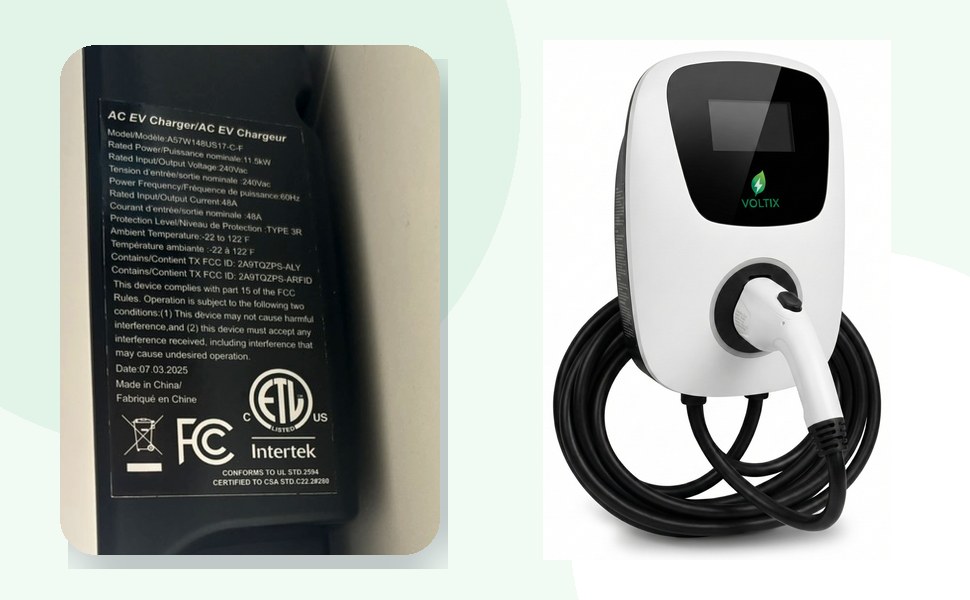
The mark tells you who tested the product; the standard tells you what they tested it against. For EV chargers, that standard is UL 2594 in the U.S. and CSA C22.2 No. 280 in Canada — a trinational standard (aligned with Mexico's NMX-J-677-ANCE) covering electric vehicle supply equipment specifically: ground fault protection, temperature limits, connector interlocks, and enclosure integrity. A charger that's "ETL Listed" without a stated standard, or that only references a generic electrical or extension-cord standard, isn't the same thing as one certified to UL 2594 / CSA C22.2 No. 280. Look for both the lab mark and the standard number on the product listing or nameplate.
Type 3R: what "outdoor rated" actually covers
Type 3R (the enclosure rating, tested as part of UL 2594 / CSA C22.2 No. 280 compliance) is what lets a charger be mounted outside or in an unheated garage. It's rated for indoor and outdoor installation, including rain, snow, and sleet exposure, with drainage designed in so moisture doesn't pool inside the housing. It is not the same as a Type 4 or IP65/66 rating — those add protection against wind-driven dust and direct water jets, which Type 3R doesn't test for or claim. If a listing describes a Type 3R product as "waterproof" or "fully sealed," that's the seller overstating the rating, not a feature of the standard itself.
Energy Star: efficiency, not safety
Energy Star is a separate, voluntary program confirming a charger meets efficiency benchmarks — it says nothing about electrical safety testing on its own. A charger can carry an Energy Star mark and still lack a valid NRTL safety listing. Treat the two as answering different questions: is it safe to install and operate (ETL/UL/CSA), and is it efficient to run (Energy Star).
A quick checklist before you buy
- Look for an actual lab mark on the product image or nameplate — ETL or UL, not just the word "certified" in the description.
- Check that the listing states the standard: UL 2594 and/or CSA C22.2 No. 280 for North America.
- For outdoor or garage mounting, confirm the enclosure rating (Type 3R at minimum) rather than trusting words like "waterproof."
- Treat Energy Star as an efficiency bonus, not proof of electrical safety certification.
- If a rebate program is in play, some require the exact model to appear on an approved-equipment list — certification alone doesn't guarantee program eligibility. Check our Incentive Finder.
Voltix is ETL Listed to UL 2594, certified to CAN/CSA-C22.2 No. 280, Type 3R rated, and Energy Star certified — all four checked against the criteria above. For a fuller buying checklist beyond certification, see our guide to the best Level 2 EV charger for Canadian homes.
Certified, and built for Canadian weather
Voltix is ETL Listed to UL 2594, CSA C22.2 No. 280 certified, Type 3R rated, and Energy Star certified.
Rebate deadlines & new guides, by email
Charger rebate rules and approved-model lists change. Get a short note when programs change or we publish a new guide. No spam.