
Buyer Guide · September 14, 2026
How Long Should Your EV Charger Cable Be? Cable Length and Where to Mount a Home Charger
Cable length is one of the most common reasons a home charger install disappoints. The unit works fine, but the plug doesn't quite reach the charge port, or it only reaches if you park at an angle. Here is how cable length actually works, why nearly every home charger tops out at 25 feet, and how to pick a mounting spot before you buy.
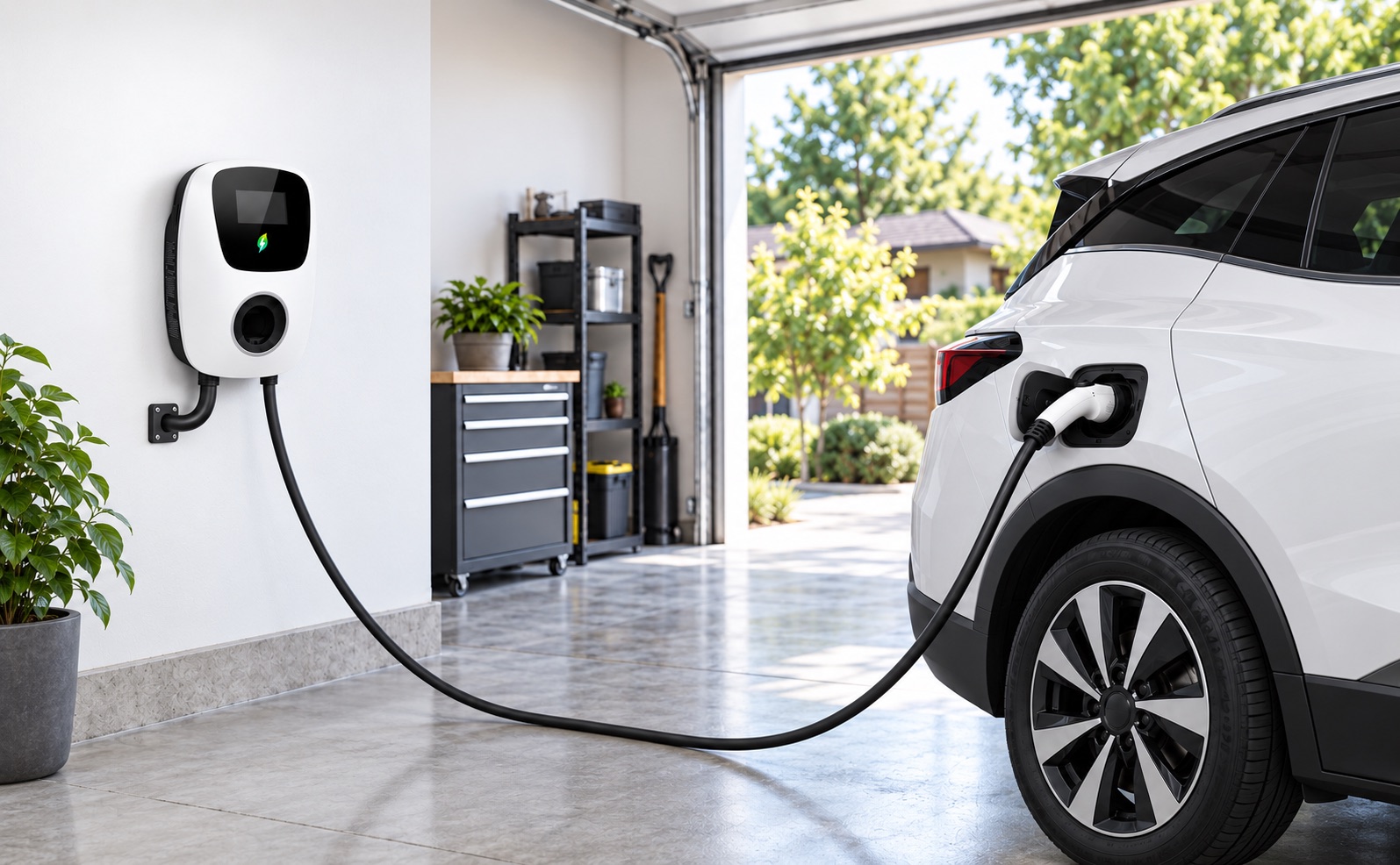
Why almost every home charger stops at 25 feet
It is not a cost-cutting decision. In the U.S. National Electrical Code, Article 625.17 limits the usable output cable of a wall-mounted charger to 7.5 m (25 ft) unless the equipment includes a listed cable management system, such as a retractor or overhead reel. The Canadian Electrical Code takes a similar approach to charging cable length, and the safety standards chargers are certified to (UL 2594 in the U.S., CAN/CSA-C22.2 No. 280 in Canada) are written around that same design. So when you see 25 ft on a spec sheet, that is the practical ceiling for a standard residential unit, not a mid-range option. Chargers sold with 16, 18, or 20 ft cables are giving you less reach, not a "standard" length.
The other reason longer cables are rare: a 48A charger pushes a lot of current, and the conductor has to be sized so the cable stays within its temperature rating along its whole length. Longer runs mean thicker, heavier, stiffer cable, which is harder to handle in a cold garage in February. Twenty-five feet is where the code limit, the certification standards, and everyday usability all line up.
How to measure what you actually need
The usable length is measured from where the cable exits the charger to the face of the connector, and the number that matters is the path the cable will follow, not the straight-line distance. Stand where the charger will be mounted, then walk the route the cable will take: down the wall, across the floor or around the front bumper, and up to the charge port. A cable never runs perfectly straight; it drops from the unit, loops on the ground, and rises to the port. Add roughly 3 to 5 feet to your walked distance for that slack, and add more if you want the option of parking the other way around or charging a second vehicle in the next bay.
Check where the charge port is on your specific vehicle before you settle on a wall. Ports vary: rear-quarter on the driver's side for Tesla and many Hyundai and Kia models, front fender on many Ford, Chevrolet, and Nissan models, and front-centre on some others. If you are buying an EV soon rather than already owning one, plan for the worst-case corner. A 25 ft cable from a mid-wall mount will typically reach any port on a vehicle parked in a standard single-car garage, and most two-car garages if the unit is mounted between the bays.
Where to mount the charger
The mounting spot decides how much of your cable you actually get to use. A few practical rules: mount the unit so the cable reaches the port without crossing a walkway or the path of a garage door; keep it close enough to the panel that the electrician's conduit run stays reasonable (a shorter run is cheaper); and mount it high enough that the cable hangs rather than piling on the floor, roughly 42 to 48 inches to the connector holster is common. For a two-car household, a spot on the shared wall or a pillar between the two bays lets one charger serve either vehicle.
Outdoors is a legitimate option. A charger that is Type 3R rated, like the Voltix, is designed for outdoor installation with rain, snow, and sleet exposure, so a driveway mount on the house wall or a post is workable. Just remember that the cable has to reach the port from wherever the car sits in the driveway, and that snow banks change where that is. On a driveway, the cable route is usually the deciding factor, so measure in the real parking position, not from the wall.
What not to do
Do not extend the reach with an extension cord, and do not buy a longer replacement cable and swap it yourself. Both defeat the certification the charger was tested to, and extension cords are a recognized fire risk under sustained Level 2 loads. Ontario's Electrical Safety Authority ran a Toronto safety blitz and found hundreds of unpermitted installs, extension cords across sidewalks, and chargers mounted on trees. If the cable does not reach, the right fix is moving the charger, moving how you park, or choosing a unit with the full 25 ft in the first place.
Cable length is also not a speed decision. A 48A charger delivers the same 11.5 kW whether the cable is 18 or 25 feet; what changes is only where you can park. If you are still weighing output, our 48A vs 40A guide covers that side, and the speed calculator shows what 11.5 kW means for your vehicle.
Not sure where the unit should go?
A licensed electrician will confirm the mounting location, cable route, and panel capacity on a site visit. You can request quotes from independent licensed contractors through our installation page.
Get installation quotesThe short version
Buy the full 25 ft; it costs little more and is the maximum a standard residential charger can ship with. Walk the cable's real route and add slack before you choose a wall. Mount between bays if you have two vehicles, and think about the winter parking position if the charger is going outdoors. The Voltix 48A charger ships with a 25 ft cable and is Type 3R rated for indoor and outdoor installation, which covers most garages and driveways in a typical Canadian home. If a rebate applies where you live, the Incentive Finder will tell you before you buy.
25 ft of reach. 11.5 kW of output.
Voltix is a 48A hardwired Level 2 charger with a 25 ft cable, ETL Listed to UL 2594, Type 3R rated for indoor and outdoor installation.
Buy on Amazon.caNeed it installed? Request installer quotes.
Rebate deadlines & new guides, by email
Charger rebate rules and approved-model lists change. Get a short note when programs change or we publish a new guide. No spam.